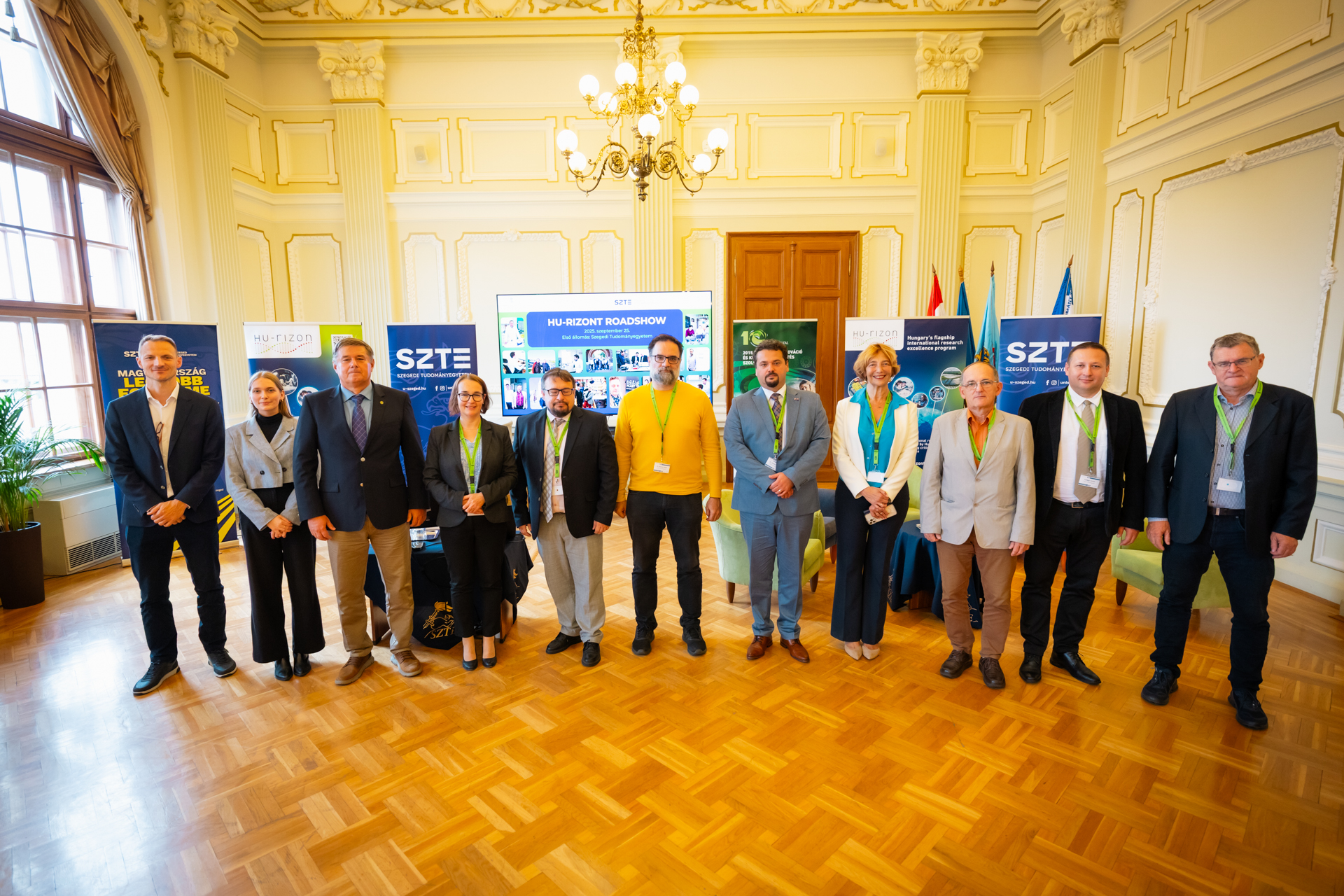
Launched by the National Research, Development and Innovation Office (NRDI Office), the HU-rizont Program’s first year brought major recognition for the University of Szeged, with eight of its research projects winning support – one-third of all funded proposals nationwide. SZTE was the only institution in Hungary to earn grants across every thematic focus, cementing its role as a national leader in research and innovation. To mark the close of the inaugural year, the NRDI Office has organized a roadshow, inviting Hungarian universities to showcase their projects. The University of Szeged had the distinction of hosting the very first stop in the series.
In a welcome video message screened at the Szeged event, László Bódis, Deputy State Secretary for Innovation, described HU-rizont as a flagship program designed to help integrate Hungary’s research ecosystem into the international scientific landscape. In 2024, researchers submitted 112 proposals, of which 30 received funding – totaling 12 billion forints. The Deputy State Secretary also noted that submissions have increased to 132 in the program’s second year, with funding decisions expected in November.

Prof. Dr. László Rovó, Rector of the University of Szeged
Photo by Ádám Kovács-Jerney
SZTE’s winning researchers were welcomed by Prof. Dr. László Rovó, Rector of the University, who emphasized that the recognition they received through the HU-rizont Program was well deserved. He noted that SZTE demonstrated outstanding performance this year, having been named Hungary’s Innovative University of the Year 2025 and once again topping the Academic Ranking of World Universities (ARWU) as the highest-ranked Hungarian institution – well ahead of its peers. The Rector highlighted all eight of the HU-rizont research projects overseen by the University’s Center of Excellence for Interdisciplinary Research, Development, and Innovation (IKIKK), stressing that they tackle some of the world’s most pressing challenges. He also underscored the role of IKIKK’s cutting-edge infrastructure in keeping these projects internationally competitive and attractive to major global partners.
At the event, Dr. László Lengyel, Vice President for Science and International Affairs of the NRDI Office, emphasized that while scientific collaboration is a key goal of the HU-rizont Program, it is equally important to engage young researchers and build a national research community – one in which participants can regularly exchange insights and experiences.

Dr. Judit Fendler, Chancellor of the University of Szeged
Speaking at the Szeged event, Dr. Judit Fendler, Chancellor of the University of Szeged, presented the institution’s Advanced Core Facilities (ACF) as a key driver of SZTE’s success in the HU-rizont Program. She explained that the ACF infrastructure supports institution-wide objectives and strengthens SZTE’s global competitiveness by attracting top international researchers. “This includes the scaled, structured, and market-oriented use of our equipment,” Dr. Fendler noted, adding that this approach also creates value by drawing international partners and generating knowledge that can be further integrated into the university’s research activities.

Prof. Dr. Mihály Boros
The first featured project of the HU-rizont Day event was presented by Prof. Dr. Mihály Boros, university professor at the Institute of Surgical Research of the University of Szeged. His research group is working to develop a new non-invasive method for diagnosing certain diseases associated with impaired intestinal circulation – based on the analysis of exhaled breath. The SZTE team is working on the project in a consortium together with Heidelberg University of Germany and the Ludwig Boltzmann Institute in Austria.
Representing the research group led by Dr. Attila Gácser, microbiologist Dr. Renáta Tóth presented a collaborative project carried out with the University of Pennsylvania (USA) and King’s College London (UK), aimed at developing new treatment and prevention strategies for Candida fungal infections. The team’s primary focus is on creating an anti-Candida vaccine, potentially using mRNA technology. In parallel, the project explores the use of mRNA-based therapies to strengthen mucosal tissues against Candida-related damage. Currently, no functional antifungal vaccine exists worldwide – and if successful, the vaccine developed by Dr. Gácser’s group through the HU-rizont Program would be the first of its kind.

Dr. Renáta Tóth
Representing an international research consortium, Dr. Klaudia Farkas presented a project focused on developing new treatments for inflammatory bowel diseases. The collaboration brings together the University of Szeged (SZTE), the University of Tokyo (Japan), and McGill University (Canada). The research centers on the development of antioxidant nanoenzymes – nanoparticles with enzymatic activity – designed to combat the oxidative stress associated with bowel disease. This innovative approach could lead to a breakthrough in treating conditions such as Crohn’s disease. At SZTE, the development of the nanoenzymes is led by Dr. István Szilágyi, while preclinical testing is carried out by the research group of Dr. József Maléth.
Presenting his interdisciplinary research project, Dr. József Maléth of the University of Szeged’s Albert Szent-Györgyi Medical School introduced an
investigation into the health effects of micro- and nanoplastics generated during the breakdown of plastic waste.
Carried out in collaboration with the University of Cambridge (UK) and the University of Ulm (Germany), the project explores how these nanoscale plastic particles interact with the human body. Dr. Maléth emphasized that scientific understanding in this area remains limited – it is still unclear whether the impact of nanoplastics depends on their quantity, the duration of exposure, or their chemical composition, structure, or shape. The project is highly interdisciplinary: researchers at the University’s Center of Excellence for Interdisciplinary Research, Development, and Innovation (IKIKK) are examining the issue from multiple angles, including genetic, pharmaceutical, analytical-chemical, optical, and legal perspectives.

Dr. József Maléth
Presenting his research at the HU-rizont Day, Dr. Gergely Röst of the University of Szeged introduced an international project aimed at developing methodologies for rapid, coordinated responses to potential future pandemics. Conducted in collaboration with Kyoto University (Japan) and Yale University (USA), the RAPID-GRIP project goes beyond early detection and response design. As Dr. Röst explained, the goal is to accelerate, align, and consolidate these efforts within a unified global framework for pandemic preparedness.

Dr. Gergely Röst
Presenting his project at the HU-rizont Day, Prof. Dr. Zoltán Bozóki, head of the Department of Optics and Quantum Electronics at the University of Szeged, introduced a research initiative aimed at enhancing the sensitivity of photoacoustic measurement techniques. Conducted in collaboration with the University of Glasgow (UK), the National University of Singapore, and Seoul National University (South Korea), the project explores the use of metamaterials to further improve the precision of this method, which detects sound generated during light absorption. The procedure itself is a patented invention developed at SZTE’s Department of Optics and Quantum Electronics.

Prof. Dr. Zoltán Bozóki
Presenting his research at the HU-rizont Day, Associate Professor István Szilágyi of the Department of Physical Chemistry and Materials Science at the University of Szeged introduced a project investigating micro- and nanoplastic contamination in agriculture. Conducted as part of a consortium with the University of Queensland (Australia) and the École Polytechnique Fédérale de Lausanne (Switzerland), the research is supported by the Hungarian Academy of Sciences through the SZTE–MTA Momentum Biocolloids Research Group. Closely linked to the physiological studies led by Dr. József Maléth, this project forms part of the nanoplastics incubation initiative coordinated by the University’s Center of Excellence for Interdisciplinary Research, Development, and Innovation (IKIKK). Dr. Szilágyi’s team focuses on detecting, tracking, evaluating, and potentially removing nanoplastics in agricultural systems – a topic of growing importance in the context of plastic pollution, food safety, and environmental sustainability.

Dr. István Szilágyi
Presenting his research at the HU-rizont Day, Professor Márk Jelasity, head of the Competence Center for Artificial Intelligence at the University of Szeged, introduced a project focused on demystifying the “black box” nature of large language models. Conducted in collaboration with Rutgers University (USA) and Nanyang Technological University (Singapore), the research explores how these models, though highly effective on complex tasks, function without full transparency. As Professor Jelasity explained, their capabilities are based on training with massive datasets rather than on structured, intentional learning. His group aims to understand how language models internally represent knowledge – essentially mapping the world model that emerges from the relationships among words and concepts. This understanding, he noted, could help address AI-related security risks and ultimately allow us to learn from artificial intelligence in tasks that exceed human capabilities.

Prof. Dr. Márk Jelasity
As part of the HU-rizont Roadshow event, Flóra Csesznok, international officer at the National Research, Development and Innovation Office, hosted a roundtable discussion with PhD students and early-career postdoctoral researchers involved in HU-rizont projects at the University of Szeged. The conversation featured contributions from AI researcher András Balogh, mathematician Nóra Juhász, and medical researcher Attila Rutai.
To conclude the day, the NRDI Office organized a closed-door skills development workshop tailored for the participating researchers.
Source: SZTEinfo
Speakers at the HU-rizont Roadshow included:
Dr. László Lengyel, Flóra Csesznok, Prof. Dr. László Rovó, Dr. Borbála Schenk, Dr. Gergely Röst, Prof. Dr. Márk Jelasity, Dr. József Maléth, Dr. Judit Fendler, Prof. Dr. Zoltán Bozóki, Dr. István Szilágyi, and Prof. Dr. Mihály Boros